
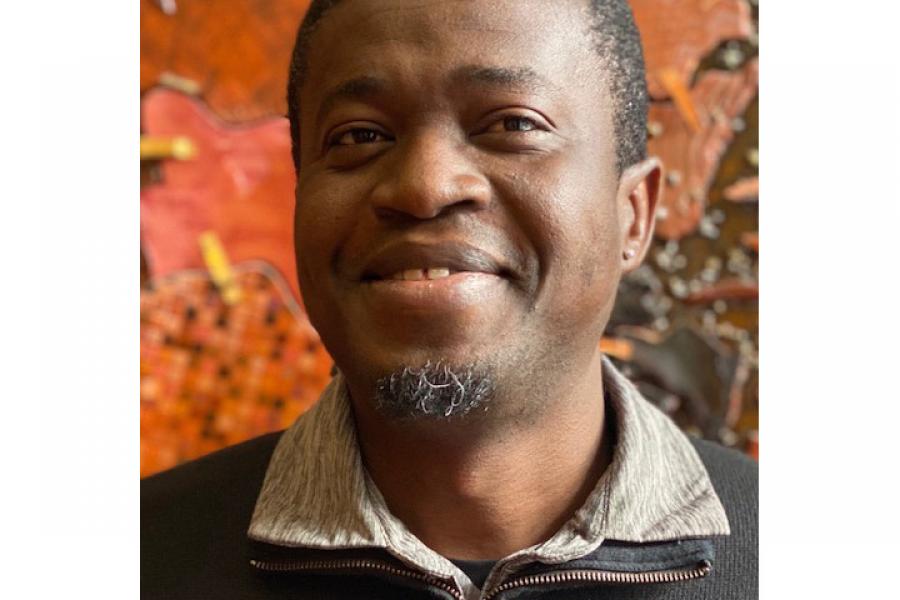
General Artist Information
Name: Dr. Hamzat Koriko
Artist Discipline: Folk Arts — Storytelling, Theatre, Drumming, Dance, Oral Traditions, Socio-Emotional Art, and Community-Based Arts
Grade Level Preference: 8-12
Geographic Availability: Throughout North Dakota: regional and national opportunities by arrangement
Fee per-day: Negotiable
Email: amoussak@gmail.com
Phone Number: (701) 739-4310
Biography
Dr. Koriko is a multidisciplinary folk artist, storyteller, playwright, actor, percussionist, teaching artist, and trained Socio-Emotional Art and Social-Emotional Learning (SEL) practitioner based in Grand Forks, North Dakota. Originally from Togo, West Africa, his artistic practice is rooted in African oral traditions and brings together storytelling, theatre, drumming, movement, dance, poetry, and community-based art.
Dr. Koriko is the founder and CEO of Kori Art, a North Dakota-based nonprofit arts organization dedicated to using traditional and contemporary arts to create opportunities for cultural exchange, artistic education, creative expression, and belonging. His work is grounded in the belief that folk arts are living practices through which individuals and communities preserve memory, transmit knowledge, build relationships, and understand themselves and one another. A trained actor and storyteller, Dr. Koriko has worked with artists and theatre institutions in West Africa, France, Italy, and the United States. His practice combines traditional West African storytelling techniques with contemporary theatre and participatory arts. His performances and residencies frequently incorporate spoken narrative, drumming, rhythm, call-and-response, movement, dance, music, improvisation, and audience participation.
As a trained Socio-Emotional Art and Social-Emotional Learning practitioner, Dr. Koriko also uses artistic practice to support reflection, self-awareness, empathy, relationship-building, communication, and creative expression. Rather than separating artistic development from emotional and social development, his approach recognizes that storytelling, rhythm, movement, theatre, and other folk-art practices can provide meaningful ways for participants to explore emotions, experiences, relationships, identity, and belonging. Cultural transmission is central to Dr. Koriko’s artistic practice. For more than six years, he has taught and mentored young African immigrant artists through apprenticeship and traditional arts initiatives supported by the North Dakota Council on the Arts (NDCA). Through these experiences, he shares storytelling, drumming, movement, performance, cultural knowledge, and the responsibilities that accompany carrying a cultural tradition from one generation to another.
His recent work includes arts programming with older adults through the North Dakota Council on the Arts’ Arts for Life program, incorporating storytelling, memory, poetry, drumming, dance, and participatory folk arts. His Where I’m From elder memory poetry project invited older adults to explore memories of childhood, family, home, work, landscape, and community and transform those memories into creative expression.
Dr. Koriko’s publications include The Case of the Missing Girl: Exploring Sex-Selective Abortion (LAP Lambert Academic Publishing, 2019), L’Ombre de nuit (L’Harmattan, 2012), and Quand l’oiseau s’envole (L’Harmattan, 2007). He has also published scholarly work on African theatre and identity. His English translation of Quand l’oiseau s’envole (When the Bird Takes Flight) was invited to the Kennedy Center through the Kennedy Center American College Theater Festival. He was a featured author at the 42nd Annual UND Writers Conference. His artistic and professional development has been recognized through several fellowships and awards, including selection as a National Arts Strategies Fellow in 2020, a National Endowment for the Arts Translation Fellow in 2021, a Change Network Fellow in 2023, and recipient of the 2023 Waterers Award.
Dr. Koriko also teaches art and humanities courses in the University of North Dakota Honors Program. His current teaching includes FA 150HON: Introduction to Art — Exploring “Why Does Art Matter?” His university teaching complements his work as a teaching artist by encouraging students to examine how artistic expression shapes memory, identity, culture, human relationships, and our understanding of the world. At the center of Dr. Koriko’s practice is a simple idea: art is something people do together. Stories, rhythms, movements, songs, and memories become ways of passing knowledge between generations, strengthening relationships, and creating spaces in which people can see themselves while learning to see others.
Teaching Philosophy
My teaching philosophy begins with a simple approach: “I do, we do, you do.” I first demonstrate an artistic process. We then explore and practice it together. Finally, students use what they have learned to create, interpret, and perform something of their own.
I believe every student enters an artistic space carrying knowledge. They bring stories, memories, emotions, rhythms, languages, movements, family traditions, and lived experiences. My responsibility as a teaching artist is to create an environment in which students can recognize those resources and transform them into artistic expressions.
My training in Socio-Emotional Art and Social-Emotional Learning also informs how I structure artistic experiences. Art can help students develop self-awareness, confidence, empathy, communication, collaboration, and a stronger awareness of others. A story can provide a safe structure for examining a difficult emotion. Rhythm can create connection within a group. Movement can communicate something that a student may not yet have words to express. Theatre allows students to temporarily enter another person’s perspective.
For this reason, I do not approach storytelling simply as learning how to perform a story. Storytelling also teaches us how to listen. My teaching draws upon African oral traditions, storytelling, theatre, movement, drumming, rhythm, music, improvisation, and reflection. Whenever possible, I begin with something familiar, family story, a childhood memory, a place, an object, a sound, a gesture, or an experience—and invite students to discover its artistic possibilities. The arts can make the familiar strange enough for us to examine it differently, while making what initially appears strange or unfamiliar more understandable and human. Ultimately, my goal is not simply to produce better performers. I want students to become more curious, expressive, confident, empathetic, imaginative, and attentive to the stories carried by the people around them.
Sample Residency Information
Residency Title: The Craft of Storytelling: Story, Rhythm, Movement, and Belonging
- Grades 6-12
- Adaptable for: College students, adults, educators, older adults, and intergenerational groups
Number of Sessions: 10 sessions; 50 minutes per session.
Description:
The Craft of Storytelling introduces students to storytelling as a living folk-art tradition and as a creative practice for exploring identity, memory, emotion, culture, and belonging.
Drawing upon West African oral traditions, contemporary storytelling, theatre, drumming, movement, and Socio-Emotional Art practices, students discover that stories can be communicated through more than words. Voice, gesture, rhythm, movement, music, silence, facial expression, and audience interaction all become part of the storytelling vocabulary.
Students begin with what they already know: their own memories, families, neighborhoods, cultural traditions, emotions, and experiences.
From there, Dr. Koriko introduces storytelling and performance techniques including character development, improvisation, call-and-response, rhythm, movement, voice, drumming, and ensemble work. Students explore selected Togolese and West African storytelling traditions while considering how stories preserve knowledge and travel between generations and communities.
The residency also incorporates age-appropriate Social-Emotional Learning principles, providing opportunities for students to develop self-awareness, communication, empathy, collaboration, responsible creative choices, and respect for different experiences and perspectives. Students gradually move from working with existing stories to developing individual and collaborative narratives. The residency can culminate in an informal story circle, classroom presentation, or public sharing.
The central message is simple: Everyone carries a story. Every story carries knowledge. And when we learn how to listen to one another’s stories, art can become a place of connection.
Short Lesson Plan
Each session will follow the same format:
Warm-up: (5 minutes)
Students participate in stretching, breathing, vocal, rhythm, and movement exercises. Some activities draw inspiration from Jacques Lecoq’s concept of the corps poétique or “poetic body,” inviting participants to discover how the body can communicate emotions, images, characters, relationships, and stories without relying exclusively on spoken language. The warm-up also helps students become aware of themselves, the group, and the creative space.
Activities-Practices (40 minutes)
Activities follow the “I do, we do, you do” model.
I Do:
Dr. Koriko introduces and demonstrates an artistic technique. Depending on the session, this may involve storytelling, voice, character, improvisation, rhythm, drumming, call-and-response, movement, emotional expression, or transforming a personal memory into a narrative.
We Do:
Students practice the technique collectively. The group may work with a traditional story, folktale, shared memory prompt, rhythm, movement sequence, or improvisational exercise.
You Do:
Students work individually, in pairs, or in small groups to apply the technique creatively. They may develop characters, create short narratives, transform memories into stories, develop rhythmic patterns, combine movement and spoken language, or experiment with different ways of expressing an emotion or experience artistically.
Throughout this process, students practice both artistic skills and social-emotional skills such as listening, collaboration, self-awareness, communication, empathy, and respect for different perspectives.
Cool down- (5 minutes)
Students return to the group for reflection.
Rather than focusing only on whether a performance was “good,” reflection encourages students to think about both the artistic process and their experience of participating in it.
Questions may include:
What did you discover today?
What emotion was easiest or most difficult to communicate?
How did rhythm or movement change the story?
What did you learn from someone else’s story?
How did your group make decisions together?
What happened when you listened instead of preparing what you wanted to say next?
What would you change if you told the story again?
Reflection reinforces an essential principle of Dr. Koriko’s practice: storytelling is an art of speaking, but it is equally an art of listening.
Expected Student Outcomes
By the completion of the residency, students will be able to demonstrate basic oral storytelling and performance techniques; use voice, rhythm, movement, gesture, and music as storytelling tools; understand storytelling as a living folk-art tradition and form of cultural transmission; create or adapt a story for performance; collaborate respectfully in an artistic ensemble; identify connections among art, memory, emotion, identity, and culture; demonstrate increased confidence in creative expression; practice active listening and empathy; reflect on their own artistic and emotional development; and recognize the value of their own stories while developing greater curiosity about the stories of others.